[1] K.-M. Lin, P.-J. Chen, C.-P. Chuu, Y.-C. Chen* Effects of insertion of an h-AlN monolayer spacer in Pt-WSe2-Pt field-effect transistors. Sci. Rep. 14, 24019 (2024).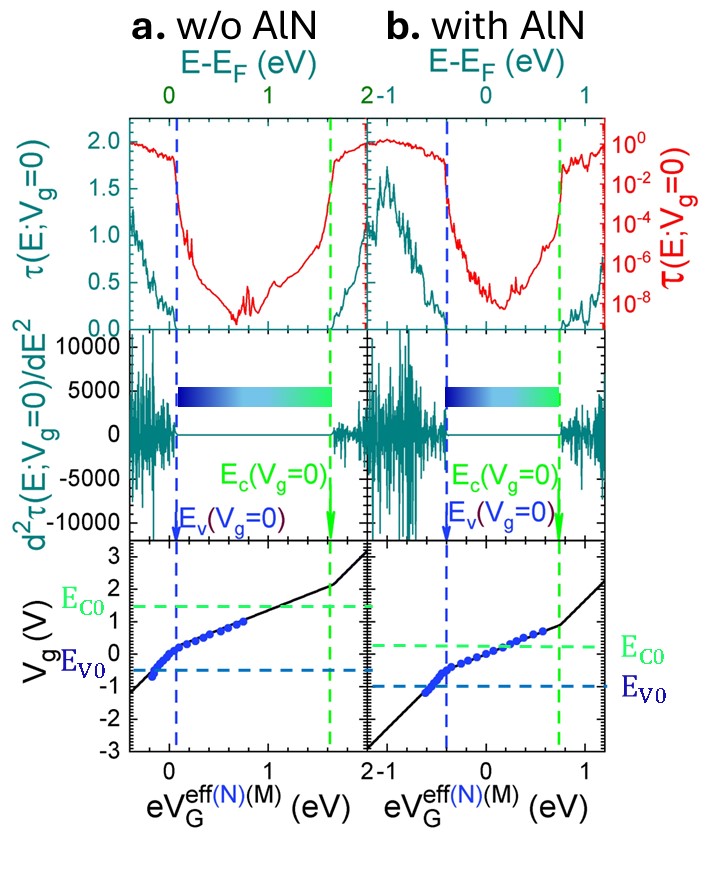
Figure: Band gap of the transmission function and the position of chemical potential shifted by the effective gate model, , for the Pt–WSe2–Pt transistors (a) without and (b) with h-AlN, respectively.
We established an effective gate model, . The relative error between the current calculated using the effective gate model and that obtained directly from NEGF-DFT is bounded by , where S.S. denotes the subthreshold swing. As a result, the effective gate model significantly improves the computational efficiency of studying gate effects in two-dimensional metal–TMD–metal field-effect transistors. It greatly reduces the required computational time and resources while maintaining reliable accuracy.
[2] Y.-C. Lin, K.-M. Lin, Y.-C.Chen* Quantum transport calculations: an effective medium theory based on the projector augmented wave method with the plane-wave basis. Phys. Rev. B 112, 085155 (2025).
Figure: (a) EMT-PW connect band structures with transmission coefficient in quantum transport. (b), (c), and (d) compare obtained by EMT-PW and NEGF-DFT.
We developed the EMT-PW method to advance quantum transport theory by establishing a direct connection between electronic band structures and transmission coefficients. Implemented within the plane-wave basis of VASP, EMT-PW provides a rigorous benchmark against conventional LCAO-based NEGF-DFT methods. It inherits the high accuracy of VASP while avoiding the overcompleteness issue commonly encountered in localized-orbital approaches. By constructing field operators from first-principles wave functions, EMT-PW also provides a robust theoretical foundation for incorporating quantum field theory into first-principles transport calculations, thereby opening new opportunities for studying many-body effects in nanoscale quantum systems.
[3] Y.-C. Chen*, C.-Y. Ling, K.-M. Lin Classical-to-quantum crossover in 2D TMD field-effect transistors: a first-principles study via sub-10 nm channel scaling beyond Boltzmann tyranny. Appl. Phys. Rev. 13, 011409 (2026). Selected as a FEATURED ARTICLE in APR.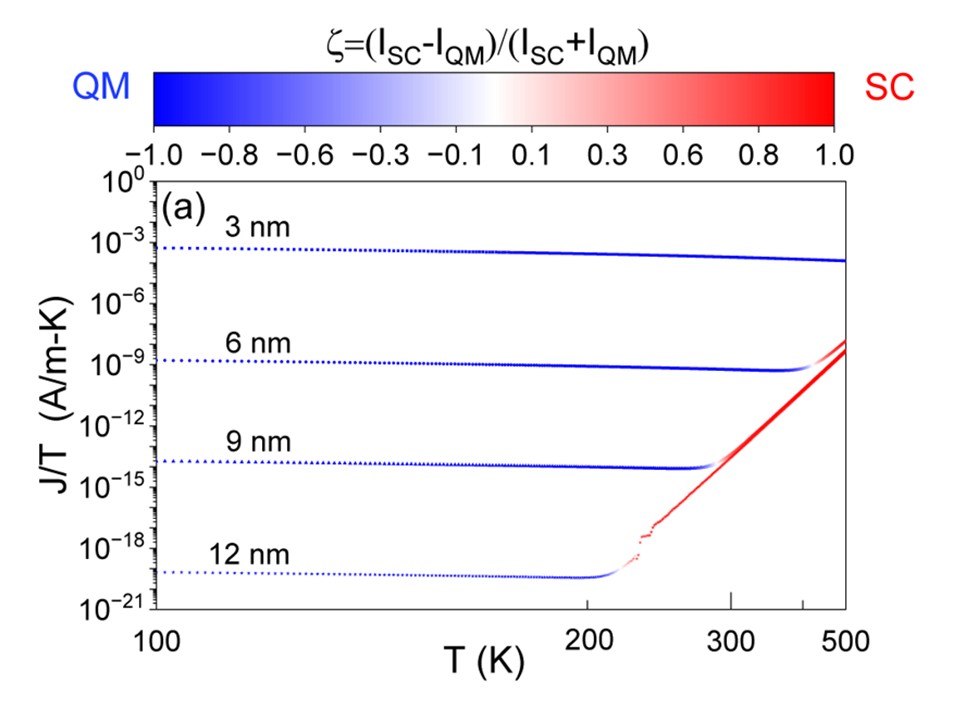
Figure: We demonstrated that the slope of (J/T) versus (1/T) changes due to a transition in the dominant transport mechanism, from quantum-mechanical tunneling at low temperatures to semi-classical thermionic emission at high temperatures. As the channel length of Pt–WSe2–Pt field-effect transistors is scaled down from 12 nm to 3 nm, quantum transport becomes increasingly dominant.
We prove that the Landauer formula in quantum transport asymptotically approaches Richardson’s law in the semi-classical transport regime, consistent with the correspondence principle in quantum mechanics. This connection enables us to investigate the classical-to-quantum crossover in electron transport properties of sub-10 nm two-dimensional TMD field-effect transistors. The quantum tunneling current is only weakly affected by temperature but decreases exponentially with increasing channel length. In contrast, the classical thermionic emission current increases exponentially with temperature due to the enhanced population of thermally excited electrons, while remaining nearly independent of the channel length. Moreover, the slope of (J/T) versus (1/T) in the semi-classical regime can be used to estimate the work function between the metal electrode and the TMD channel.
[4] Y.-C. Chen*, Y.-C. Chang, Thermoelectric optimization and quantum-to-classical crossover in gate-controlled two-dimensional semiconducting nanojunctions. ACS Nano 19, 34906-34917 (2025). Also featured in Advances in Engineering.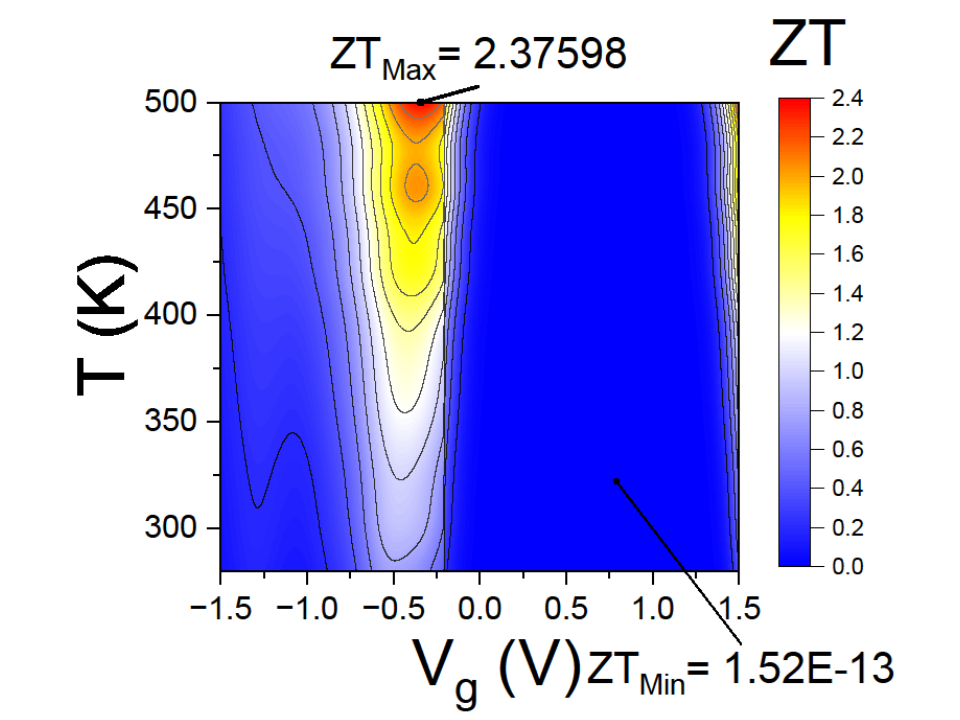
Figure: Thermoelectric figure of merit ZT of the metal-WSe2-metal FET thermoelectric junction.
By combining NEGF-DFT with an effective gate model and nonequilibrium molecular dynamics simulations, we systematically investigate gate-voltage-tunable thermoelectric transport in Pt–WSe2–Pt nanojunctions with transistor-like structures. We analyze the electrical conductance, Seebeck coefficient, electronic thermal conductance, and thermoelectric figure of merit, ZT, as functions of channel length, temperature, and gate voltage. Our calculations predict a maximum ZT exceeding 2, demonstrating that gate-controlled Pt–WSe2–Pt nanojunctions are promising candidates for high-performance two-dimensional nanoscale thermoelectric devices.
[5] Y.-C. Lo, L.-J. Wang, Y.-C Chen* Bandgap engineering of nitrogen-doped monolayer WSe2 superlattice and its application to field effect transistor. Adv. Electron. Mater. 12, e00754 (2026).
Figure: Increasing the doping periodicity monotonically reduces the band gap, thereby substantially modifying the device switching behavior, including the current density and subthreshold swing (S.S.).
Periodic nitrogen doping in WSe2 restores translational symmetry and creates superlattice structures, resulting in band-gap modulation and chemical-potential shifts. In this study, we propose a superlattice-based periodic-doping strategy to engineer Pt–WSe2–Pt thermoelectric junctions. By leveraging the resulting band-gap engineering effect, we further explore periodically doped TMDs as promising channel materials for field-effect transistors (FETs).